Science for Animal Welfare
Science in the service of animal welfare
Registered Charity Number: 207996
Wheathampstead, Hertfordshire
Goat kids need to be treated differently from calves
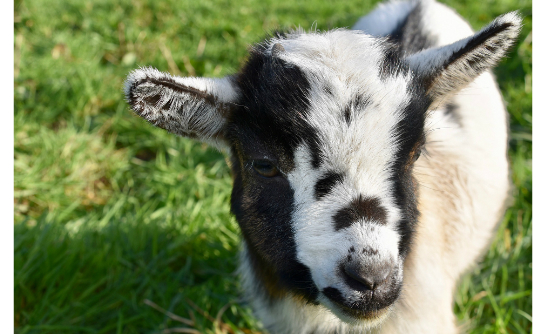
GOAT KIDS ARE NOT SMALL CALVES AND NEED TO BE TREATED DIFFERENTLY, REVIEW CONCLUDES
Results point to a need to develop best practice guidelines for disbudding that are specifically for goat kids
Limited scientific literature is available for developing ‘best practice’ guidelines for the management of dairy goats, with disbudding practices for goat kids and calves appearing to be similar. However, according to a recent review carried out by scientists in New Zealand and published in UFAW’s scientific journal, Animal Welfare there is a real need for kids to be treated differently from calves.
There are welfare concerns relating to disbudding (removal of the horns) but this procedure is routinely carried out on both calves and goat kids to avoid injury to other animals, farm workers and damage to the animals’ environment. Disbudding is performed on kids and calves at an age when the horn buds are evident, but before they attach to the underlying skull, with kids generally disbudded at a much younger age than calves. However, once the horns of goats have fused with the skull and a horn is clearly visible, disbudding is ineffective, and horns must be removed by amputation with either a saw or wire dehorning.
There are a variety of methods for disbudding, including the use of a hot cautery iron, applying caustic paste, injecting clove oil, and directing a pressurised spray of liquid nitrogen onto the horn bud (cryosurgical disbudding). The most commonly used method for both kids and calves is to use a hot cautery iron to either remove the ring of tissue containing the horn bud cells by cutting it to the bone and then forcibly flicking it off the head or burning the horn bud, but leaving it intact. This also appears to be the most effective method of preventing scur and horn growth, especially when the horn bud is fully removed. However, cautery disbudding is painful and, if performed by unskilled operators, can cause damage to the brains of goat kids due to the skull being thinner than a calf’s.
The extensive review considered existing scientific literature, compared the disbudding methods for calves and kids, reviewed the behavioural and physiological responses of the two species to disbudding and identified alternatives to disbudding along with refinements of current practices (eg pain management strategies).
The review concluded that the effect of iron temperature and application (eg how long the iron is applied, and how much pressure should be applied to remove the horn bud) deserved special consideration to reduce pain and injury, and to increase effectiveness. Pain and injury associated with disbudding could be eliminated by changing herd management to allow for horned goats, or breeding and farming polled (hornless) animals. The scientists also found that, based on the literature they reviewed, it appears that alternative disbudding methods, including caustic paste and cryosurgical disbudding, are more painful than cautery disbudding and may not be useful alternatives. Although clove oil injection appears to cause a similar experience of acute pain as cautery disbudding, the method (as currently applied) may cause longer-term inflammatory pain, and is ineffective at preventing horns and scurs; therefore clove oil injection may not be a viable alternative to cautery disbudding.
General anaesthesia and non-steroidal anti-inflammatory drugs (NSAIDs) can reduce pain during and following cautery disbudding of goat kids. However, local anaesthesia with lidocaine, as currently applied, does not appear to reliably reduce pain associated with disbudding of goat kids and the review therefore recommended that the effect of dosage, formulation and/or method of application (eg injected versus topical) should be investigated. Pain relief that is affordable, practical (eg easy to administer) and safe for both humans and the goats they manage is most likely to be adopted by farmers.
The journal paper’s main author, Dr Melissa Hempstead, said: “Until a less painful and efficacious alternative is realised, it appears that adapting cautery disbudding methods using pain mitigation is the best option currently available for farmed dairy goats. In order for the industry to establish best practice guidelines for disbudding goat kids, managers must recognise that goat kids are not small calves.”
-ENDS-
While you explore the various charitable opportunities on Charity Choice, take a moment to relax and discover something exciting. Visit Vavada Casino for a thrilling break that adds a bit of excitement to your day.