Universities Federation For Animal Welfare
Science in the service of animal welfare
Registered Charity Number: 207996
Wheathampstead, Hertfordshire
Animal Welfare Student Scholars present to their peers
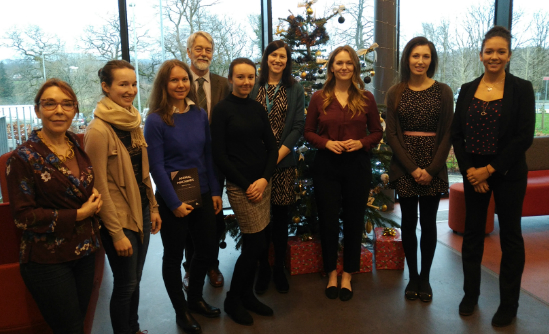
Animal Welfare Student Scholars
An important part of the learning experience provided by the UFAW Animal Welfare Student Scholarships is that scholars give a talk on their research to an audience of their peers. This year the scholarship meeting was held at the School of Veterinary Medicine at the University of Glasgow on December 12th.
The audience of staff and students from Glasgow, Myerscough College and elsewhere listened to talks on a range of subjects. Amongst these were, Theresia Bishof (University of Natural Resources and Life Sciences, Vienna, Austria) talking on her attempts to better understand and increase the use of the creep area in piglets, Emily Hendry (University of Glasgow, UK) looked at the insights gained from the use of infrared thermography on footpad dermatitis in broilers and Nicole Regan (Royal Veterinary College, UK) explored how drugs used to treat epilepsy in dogs impacted on their food-motivation and could lead to issues with obesity. Adele Aynsley (Aberystwyth University, UK) also discussed the issues she encountered in trying to develop an automated system to investigate depression in horses. Professor Georgia Mason (Campbell Centre for the Study of Animal Welfare, University of Guelph, Canada) kindly gave a plenary presentation on some of her recent work. Professor Mason is a leading international animal welfare scientist and a past winner of the UFAW Medal for Outstanding Contributions to Animal Welfare Science. In a fascinating, astute and compelling presentation, Professor Mason detailed how she and her students have used phylogenetic comparative methods to gain an insight into animals and their needs. Building on her longstanding interest in captive carnivores, she explained how a species’ natural ranging behavior impacts their ability to adapt to captivity, with animals like the polar bear that range over very large areas annually being highly predisposed to showing stereotypic route-tracing. She presented new results from her student Miranda Bandeli, on what is it about being wide-ranging that makes such species hard to keep. For example, is it that they need to walk long distances every day? Is it that they have large hippocampi (a part of the brain responsible for spatial memory and navigation)? Is it simply their nomadic lifestyle? Professor Mason explored the case for each of these, and other, hypotheses.
At the meeting, in addition to giving a talk on her research, scholar Freija Maulbetsch (University of Natural Resources and Life Sciences, Vienna) was awarded the Farm Animal Care Trust (FACT) scholarship, given in memory of Ruth Harrison, for her project Chilled or bored? Inactivity in fattening cattle. Freija was presented with a copy of Ruth Harrison’s seminal work Animal Machines.
While you explore the various charitable opportunities on Charity Choice, take a moment to relax and discover something exciting. Visit Vavada Casino for a thrilling break that adds a bit of excitement to your day.